Top 10 Visions Of The World In 1000 years

“What will the world will be like in 1,000 years”-  World In 1000 years, seems like an absurd question to even ask, especially since the degree to which the world changes in 100 years is overly ambitious enough to consider.  Yet curious people do wonder, and certain people like Ray Kurzweil (thought by many to be the Thomas Edison of today) spend all their time working to find the answers.
In honor of our 1,000th Toptenz article, Ray is going to take the podium to share with us some of his ideas about the future.  According to Ray, some of the same people living today will still be around in 1,000 years!  Technological visionary, leading inventor of our time, the recipient of the National Medal of Technology, inductee into the National Inventor’s Hall of Fame, and the recipient of 19 Doctorates and Honors from 3 U.S. Presidents, Ray gives us the top ten reasons to look ahead.

10.  A Future With Aliens?

alien-contact
Contact with other species, other civilizations?  With technological advancements looming large in the distance, a future with aliens may in fact be on the horizon.  Ray believes that advancements in technology will soon enable us to travel farther and longer into space, where we may encounter other planets and other life.1
According to Arthur C. Clarke, another futurist, inventor, and science-fiction writer, technology is advanced enough already for us to make contact with aliens.  To our good humor, some people already believe they have come in contact with alien life, and television shows like “Alien Hunters” and the like are around to prove it.  Ray, more of a humanist than an alien hunter, focuses more on technology and of the progress of humankind and our current world, which takes us to our next topic – the future of the Earth itself.

9.  The Future Of The Earth?1

future-earth
When people think of the future, they tend to think of the planet Earth, and the mark we are leaving on its oceans and forests, and the havoc we have brought to it.  Which lands will be swallowed up by rising sea levels?  About climate changes: how to support a rapidly growing population in respect to food, fuel and natural resources?
Many pessimists foresee the worst (many doubt we will even survive another 1,000 years).  Material greed is swallowing up the Earth’s resources faster than it can replenish itself.  The future, in this vein, sounds rather dark, but Ray believes1technology is going to help solve many environmental problems.
Still, who can stop asteroids and comets from colliding with the Earth?  Who can keep it from spinning off its axis like a marble shot out of bounds on the play yard?  And what about exploding stars in space shooting out bursts of gamma-rays stronger than millions of atomic bombs in far-away galaxies, with power strong enough to obliterate everything within millions of light years?  What kind of future exists for the Earth then?  According to Ray, much more interesting things, and less destructive possibilities, are on the horizon.

8.  Solutions To Energy And Environmental Concerns?

nanotechnology
Ray believes that environmental and energy concerns can, and will, be solved with technological solutions in the future.  He claims that that the Earth will not turn into a polluted, over-crowded, tumultuous wasteland, but instead believes that nanotechnology will be capable of cleaning up environmental damage, meet our energy needs, purify water and air, and capture the energy of the Sun through solar panels and more.
He believes that we will meet our projected energy needs by 2030, with the development of these new technologies.  Will his overly-positive predictions win out to restore the planet Earth, or will the technology only be more waste to add to the heap?  Certainly the next 1,000 years will reveal the correct answers to Ray’s claims, either about our resourcefulness or about our inability to solve the problems we have created.

7.  Population Growth Problems Solved?

population-overload
1,000 years from now, the world population is estimated to be roughly 14 billion.  Although such predictions are unlikely to be accurate, the concern is real, and more and more people are working fast and hard for solutions.  Will engineered food solve hunger and meet with growing food needs, or will it prove to be harmful to our health and environment in the end?
According to Ray, one day we will take in our nutrition like plants take in the sun, and as technology grows more advanced, our dependence on the Earth’s resources with become less and less.  Sounds like something straight out of a science fiction book, only better, if it proves to be true.

6.  Technology Of The Future

merge-with-technology
Ray calls it “the singularity,” a time when technology itself will merge with those creating it.  From devices in our eyeglasses and contact lenses, to displays being written directly into our retinas, emergent technology will not only change us, but will change everything.  There will be a time when we can use space itself to generate energy.
By changing our DNA, Ray believes that farther and farther space travel will be possible.  Sound like a technological utopia?  Certainly.  Taking it a step further, the technology we are currently creating will soon grow more intelligent than we are.  What to do then?  Simple: merge with that technology in order to compete.  Due to our slower evolutionary processes, only by doing this will we be able to survive against the uprising of future intelligent machines.  One day soon, Ray says, you will not be able to tell the difference between human and artificial intelligence.  This brings us to the next section on our list: intelligent machines.

5.  Visions Of Intelligent Machines

man-and-robot
The emergence of intelligent machines, Ray believes, will quantify in the future as another species, regardless of whether we encounter life outside of our solar system or not.  He believes we will be sharing our planet with robots, who will soon surpass our own intelligence, and only by becoming like the technology we create, will we be able to compete with those intelligent machines.  Ray says “the result will be an intimate merger between the technology-creating species and the technological evolutionary process it spawned.”
Ray explains extensively the exponential growth of technology versus the growth of evolutionary processes.  Intelligent machines will make it imperative to change ourselves and, in the process, we will be changing the evolution of life through intelligent machines.

4.  Space Exploration In 1,000 Years

galaxies
Humanity has not kept its feet on the ground and, whether it be to the limits of the Earth or our own biology, we are always on a quest to discover and explore our world, and the space beyond it.  In 1,000 years, just how far will we have gone?  According to Ray, we will have mapped out much more of the the cosmos.  We will be able to foretell future cosmological occurrences that can affect the Earth, and the repercussions that any those events could incur for humankind.
The biggest reason for space exploration, however, is not only to discover how the universe works, but to scout out new and interesting planets that have the potential to support human life, should unfavorable conditions appear.  So far, possible planets to live on that we have discovered are too far out of our reach, which brings us to our next section on the list.

3.  The Future Of Space Travel

Astronaut-in-space
Futurist Arthur C. Clarke, considered a visionary about space travel, believes it is only a matter of time before we have safe and economical space propulsion systems.  The questions, however, are not just in building that technology and making it affordable, but to change ourselves to withstand the negative effects that space travel has on the human body.  Ray believes that we will soon be able to alter our own DNA with emerging technology in order to withstand space travel, as DNA does not fare well in space. By doing so, we will be able to take farther and farther journeys out into space.

2.  Progress With Extending Human Life?

nanobot-dna
Of all that has been listed, number two probably has the most evidence to support it, specifically in recent years. Gerontologists and scientists are finding more and more evidence that the aging process can be slowed down.  Ray speaks extensively on how nanotechnology and nano-bots will slow the aging process, by travelling into the bloodstream to destroy pathogens, reverse the aging process, and correct DNA errors.  To add to that, Ray even talks about downloading the mind into another carrier, which is easily the most unlikely, but most thought-provoking, idea that Ray has introduced yet.

1.  Future Visions Of The Obliteration Of Death

immortal-man
If stopping the aging process wasn’t enough to shock you, try taking it even farther by saying that future technologies will stop aging completely, one day making death obsolete.  Ray believes that, one day, humans will live forever.  He refutes the idea that “the purpose of life is to accept death,” that “death always means a profound loss in relationships, talent and potential, but that up until now we have had no choice but to rationalize it.”
In Ray’s earlier book, “Fantastic Voyage:  Live Long Enough to Live Forever,” Ray writes about how people can start taking steps now to extend their lives, until the advancements in medical technology have a chance to catch up.  Nanotechnology will develop over time, becoming more capable to repair and restore our body parts.  Biotechnology is advancing and will soon make it possible to turn on and off enzymes, the workhorses of biology.  Current medical technology is taking its first steps in using these techniques to destroy HDL in the blood to stop atherosclerosis, as well as many other diseases.  By creating ever-increasingly powerful technology, the future means extending human life.  Life expectancy grows longer and longer every year: where life expectancy was 37 years in the 1800’s, a thousand years from now, according to Ray, it may just be infinite!
Technology merging with biology? There is no doubt you will peruse our Top Ten list with all kinds of skepticism, and you certainly should be; these are perhaps some of the most radical ideas about the future yet.  Still, for someone like Ray Kurzweil, who has accomplished great feats within his lifetime, is there some value in even considering it?  Whether you are a believer in science, futurists, in prophets or Gods, or merely in the “little things,” certainly these visions of the future are big enough to color your imagination, and light up a place where space, time and possibility surrounds us all on every side.
Written by: toptenz

World Of Secrets Mercury And Venus

According to mythology, Mercury was the messenger of the Gods. This had to do in part with its rapid motion around the Sun. It is the closest planet to the Sun, therefore it has the shortest orbital period. Also due to its proximity to the Sun, it is very difficult to see in the morning or evening twilight. It rarely gets more than 25 degrees away from the Sun.

Mercury is so close to the Sun that astronomers thought that there would probably be orbital coupling, like the Earth-Moon system (a tidally locked system). They expected the rotation period to be the same as the orbital period, so that one side of Mercury would always face the Sun, just like one side of the Moon always faces the Earth. Does the orbital period equal the rotation period for Mercury? It is a small planet and difficult to observe, so astronomers were not sure of its rotation period. They had to wait for the invention of radar to check it out. By bouncing a radar signal off the planet, they could measure the speed of its rotation and therefore determine the period of rotation (sort of the same way a highway patrol officer can get you clocked on the radar for being slightly over the speed limit on the highway). Are the orbital period and rotation period the same? No. The period for one orbit is about 88 days, while the period for one rotation is 59 days (pretty slow spinner, eh?). At first glance this doesn't seem to be very significant, but if you were to take the ratio of the periods, 59/88, you get a number close to 2/3. What's so great about that?
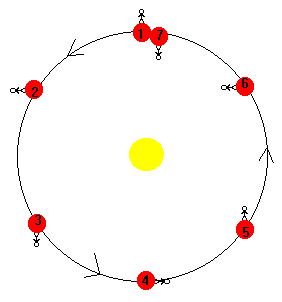
The basic upshot is that there is a kind of coupling between the orbit and rotation, but not the one that was expected. For every two orbits around the Sun, Mercury rotates three times on its axis. Figure 1 shows how the orientation of an astronaut would change over time as Mercury went about the Sun. By the time the planet had made one orbit, Mercury would have made 1.5 (or 3/2) rotations; one more orbit, and there would be a total of three rotations - sort of unusual.


Figure 1. An astronaut's view on Mercury would change slowly. An astronaut is located on the side of the planet away from the Sun to begin with (position 1). As the planet moves around the Sun and rotates on its axis (both counterclockwise, as seen here), then by the time the planet has moved 1/3 of the way in its orbit, it would have rotated around 1/2 way (position 3). One complete rotation is reached by position 5, where the astronaut is again upright, and the planet has gone 2/3 of its way in its orbit. By the time one orbit is completed (position 7), the planet has completed 3/2 or 1.5 rotations. Notice how the numbers "two" and "three" keep popping up here.
The Sun's mass influences the space Mercury occupies and adds some extra distortion to Mercury's orbit in a manner known as orbital precession. Observations of its orbit over many years showed that the locations of perihelion shifts (or you could say its orbit wobbles). Early astronomers didn't know what caused it, and even Newton's law of gravity wasn't able to adequately explain it. The distortion of space around the Sun, as described by Einstein's theory of General Relativity, helps to explain the cause of the orbital precession of Mercury, so that is one mystery that was solved by a better theory (not to say that Newton's law of gravity is lousy, but sometimes it needs help).
We don't know a lot about Mercury, in part because we haven't really spent a lot of time exploring it. Also since it is so close to the Sun and relatively small, it is very difficult to view from the Earth, even with the largest telescopes. The earliest close exploration was by the Mariner 10 spacecraft which flew by in 1974-75 and was able to photograph only 1/2 of the surface. For nearly 34 that was the best information available. In 2008, a spacecraft named MESSENGER flew past the planet for the first time. After that it flew by 2 more times before changing its orbit enough to enter into a long-term orbit about the planet. From 2011 to 2015, MESSENGER was a "satellite" of Mercury and has been able to provide us with a significant amount of new information about the planet. Before 2008, we only had images of 1/2 the surface and now we have pretty much the entire surface imaged. Messenger has provided a great deal of information about the mineral characteristics of the surface as well as information about the magnetic field and likely evolutionary history of this small world. The mission ended on April 30, 2015 when the spacecraft crashed into the surface at 8,750 mph (this was an intentional impact). It probably left a good sized crater due to this, but because we don't currently have any spacecraft around Mercury, we can't see that new crater yet. There are various videos of the things Messengerobserved at Mercury available on YouTube, so you can check those out for more information.

Future Technology that Will Change the World

Steven Pete can put his hand on a hot stove or venture on a bit of glass and not feel a thing, all due to an idiosyncrasy in his qualities. Just a couple of dozen individuals on the planet share Pete's innate heartlessness to torment. Drug organizations see wealth in his uncommon change. They likewise have their eye on individuals like Timothy Dreyer, 25, who has bones so thick he could leave mishaps that would leave others with broken appendages. Around 100 individuals have sclerosteosis, Dreyer's condition.

Both men's clear superpowers originate from exceedingly extraordinary deviations in their DNA. They are hereditary exceptions, desired by medication organizations Amgen, Genentech, and others looking for medications for a portion of the business' greatest, most lucrative markets.


Their qualities likewise have brought about the two men gigantic enduring. Pete's folks initially acknowledged something wasn't right when, as a getting teeth child, their child just about bit off his tongue. "That was a goliath warning," says Pete, now 34 and living in Kelso, Wash. It took specialists months to make sense of he had inborn lack of care to torment, brought on by two distinct changes, one acquired from every guardian. All alone, the single transformations were amiable; joined, they were destructive.

Dreyer, who lives in Johannesburg, was 21 months old when his folks saw a sudden facial loss of motion. Specialists initially determined him to have paralysis. At that point X-beams uncovered over the top bone arrangement in his skull, which prompted a determination of sclerosteosis. No one in Dreyer's family had the confusion; his folks both conveyed a solitary change, which Dreyer acquired.

Dreyer and Pete are "a blessing from nature," says Andreas Grauer, worldwide advancement lead for the osteoporosis drug Amgen is making. "It is our commitment to transform it into something valuable."

What's useful for patients is additionally useful for business. The painkiller showcase alone is worth $18 billion a year. The business is squeezing ahead with exploration into hereditary anomalies. The U.S. Nourishment and Drug Administration is relied upon to support a cholesterol-bringing down treatment on July 24 from Sanofi and Regeneron Pharmaceuticals taking into account the uncommon quality change of a heart stimulating exercise teacher with astoundingly low cholesterol levels. Amgen has a comparative cholesterol drug, in light of the same revelation, and expects U.S. endorsement in August. The medications can bring down cholesterol when statins alone don't work. They are relied upon to cost up to $12,000 per persistent every year and acquire more than $1 billion yearly.

Source: bloomberg

Do We Need The Moon?


Do we require the Moon to survive, or would we be able to manage without it? Perused on to discover… 

It is 2113. Mankind has put in the most recent 100 years stockpiling atomic warheads. Also, not only a couple – 600 billion of the biggest, greatest, deadliest warheads they can fabricate. Kind of like the Russian Tsar Bomba (the greatest atomic bomb ever exploded) in any case, well, times 600 billion. 
Add caption

Why? Since we've chosen to explode the Moon, and to do as such would require what might as well be called 30 trillion megatons of TNT. 

When we say explode, we don't simply mean somewhat explode. It couldn't be any more obvious, on the off chance that you don't totally decimate the Moon, the rest of the pieces will probably combine back together into a Moon-sized article. Without a doubt, it won't look as pretty or as circular as our cutting edge Moon, however it will be truly comparable in its gravitational impact on Earth. 

No, what we (or, all the more particularly, our future selves) need to do is totally dispose of the Moon. Along these lines, with their different rockets prepared and holding up to assault the Moon from all sides, they dispatch them towards our characteristic satellite and blow it to bits. Researchers around the globe energetically get ready for one of the best (and most imbecilic) tests ever. 

With the sections of the Moon too little to gravitationally bond together, they start to spread out. Initial, an expansive number of them head towards Earth, down-pouring liquid Moon rock down on our planet. Urban areas are wrecked, nations are wiped off the guide, and we start to think about whether exploding the Moon was such a splendid thought. 

The rest of the Moon material enters circle far and wide, shaping a ring around our planet. In any case, similar to Saturn's ring, it doesn't simply stay there. Occasionally, for whatever remains of Earth's life, shooting stars break from the ring and hammer into the surface. We're presently under consistent assault from an evidently vindictive Moon. 

Be that as it may, the Moon isn't exactly done getting even yet. Have you ever seen that the Moon is secured in cavities? All things considered, that is on the grounds that it gets beat by shooting stars, shielding Earth from a portion of the stones that travel our direction. With the Moon demolished, we're presently likewise more defenseless against space rocks. 

Obviously, one of the Moon's most discernible impacts is (or was) the tides. With the Moon no more there, the seas of the world turn out to be much more quiet. The Sun still affects them (known as sun based tides), so surfers wouldn't be totally without waves. Be that as it may, the seas would generally get to be tranquil. 

This diry affects life on Earth. At the point when life initially shaped on Earth in tidal pools, it was on account of the gravitational draw of the Moon that primordial life could cross between various pools and by and large spread over the planet. While we're as of now here now, life that is at present in the seas is no more ready to move so effortlessly. The stirring of the seas, and in this way the flow of supplements, stops. Water-based life battles to survive and, in the end, thousands (and presumably millions) of species go wiped out. 

The Moon isn't done yet, however. It likewise represented around one-eightieth of the Earth-Moon mass framework. The loss of the Moon straightforwardly influences the Earth's circle, turn and wobble. Without the Moon to go about as a stabilizer, the Earth starts to wobble increasingly, sending our seasons into turmoil and changing our circle around the Sun from marginally curved to enormously circular. We now swing around the Sun in a wild, precarious, fluctuating circle. 

As the world laments their rash choice to crush the Moon, it's now past the point where it is possible to do anything. In the event that mankind survives the steady assault from the remaining parts of the Moon and other space shakes, the annihilation of most different species from the globe, lastly the possibly calamitous occasional changes then, well, perhaps exploding the Moon wasn't such a terrible thought.

The Most Wonderful Birds On Earth

try not to make any bones about it, I really feel as if the purple martin is the most wonderful winged animal in the United States. Without a doubt, as a feathered creature watcher, I appreciate going outside seeing any flying creature. The delightful tweeting that a considerable lot of them do brings a grin to my face. Be that as it may, in my general vicinity, when I see those martins come in amid the spring, there is only something about it. The following are the two reasons why I trust the martin fowls are prettier than others we have here in the United States.


1. The Way They Fly

The purple martin flying creatures are not at all like whatever other that I have ever seen. I would say in the event that you needed to pick a winged animal that was nearest to the way the purple martin flies it would most likely be a pigeon. Martin winged creatures will fly sporadically all through the sky. The explanation behind this is they are endeavoring to catch flying bugs, for example, mosquitoes. Especially when they are settling, you will find that a significant number of them do this frequently even for the duration of the day on the off chance that they have youthful close-by.

In the event that the martins are flying high, what you will likewise frequently see them do is tuck their wings and tumble to the ground like a slug towards the perch room. At that point pretty much as they draw near, they'll swoop inside. They nearly make a 90 degree edge. They are a greatly coordinated winged creature.

2. Their Color

Clearly, the purple martin flying creatures have an exceptionally one of a kind shading. When they are in the daylight, they have a glossy and extremely obvious dull purple to them. You get the chance to see this shading regularly as they roost on their purple martin houses or in trees adjacent. These flying creatures are exceptionally social with people. This implies you can get entirely close and see your martins genuinely well.

Their shading is dissimilar to whatever other flying creature I have ever seen. It dislike a parrot which has a wide range of hues and their hues are what I call "level shading". This kind of purple is gleaming and shimmers in the daylight. Now and again they have been known not dark, however a larger number of times than not on a sunny day they will seem exceptionally purple.

In the event that you are hoping to draw in these winged creatures to your zone and live in the eastern portion of the United States. There is a decent risk you can do that. All you truly need is a well-assembled perch room and a decent area for it. It truly doesn't make a difference whether you live around the local area or not. I've seen some substantial states amidst towns some time recently!


Source: EzineArticles

Tiger killing ‘a crime against nature’ - Documentary


Three individuals have been sentenced to a sum of eight and a half years in jail for attempting to carry tiger skins and bones over the Russian fringe. What's more, without precedent for this sort of case, a charge of 'natural harm' may be brought for the tiger passings.

It's not the first run through individuals have been gotten and detained in Russia for pirating illicit tiger parts. However, so far it's general been viewed as a financial wrongdoing – the discipline has relied on upon the money related estimation of the stash seized. It hasn't mattered whether it's a sack of potatoes or a sack of tiger skins.

In this new case, three Chinese dealers captured at the Russian outskirt, in Primorsky, have been surrendered jail terms of to three years each. However, the charges won't stop there.

Since the species concerned were uncommon Amur tigers – classed as jeopardized on the IUCN's Red List of undermined species – the general population in charge of slaughtering the tigers can, if sentenced, be relied upon to pay of 500,000 roubles for every tiger.

That is around £10,000 per creature – which won't not sound an immense sum for such an intolerable wrongdoing, however for a normal Russian that could be two years' wages – and extensively more for individuals in provincial China. 

WWF specialists trust that out and out somewhere around six and ten tigers were executed to give the snack things found in this capture. That numerous tiger may regularly live over a scope of 100,000 hectares – a territory about the measure of Moscow.

We accept solid disciplines like this will be a viable obstacle against tiger poaching and the illicit exchange that is genuinely debilitating these uncommon and valuable huge felines.

Birds documentary New Bird Species Confirmed allover the world, 15 Years After First Sighting


Six astonishing winged animals 
Researchers study winged animals for some reasons—to manufacture better robots or to figure out how to live more. What they regularly find is that most feathered creatures are very astounding. Here are six-winged creatures we believe are really cool, including the feathered creature of the day: the turkey. 
1. Crows 
Like people, crows perceive faces and frame relationship with them—and to achieve this, the two species' brains seem to work in comparable ways. 
"The locales of the crowd mind that cooperate are similar to those that cooperate in warm-blooded animals, including people," says John Marzluff, University of Washington educator of ecological and backwoods sciences. "These areas were suspected of working in feathered creatures yet not reported as of recently." 
Past examination on the neural hardware of creature conduct has been led utilizing all around concentrated, frequently tamed, species like rats, chickens, zebra finches, pigeons, and rhesus macaques—yet not wild creatures like the 12 grown-up male crows in this study. 
The crows were caught by specialists every single wearing veil that the scientists alluded to as "the undermining face." The crows were never treated threateningly, however, the actuality they'd been caught made a negative relationship with the cover they saw. 
At that point, for the four weeks, they were in imprisonment, they were bolstered by individuals wearing a cover not quite the same as the primary—this one called "the minding face." The veils depended on real individuals' countenances and both bore impartial looks so the affiliations made by the crows depended on their treatment. 
2. Birds of prey 
"This is the first run through winged creatures of prey have had their genomes sequenced and the discoveries are genuinely impactful, especially in the development of Peregrine birds of prey—the quickest species in the set of all animals," clarifies Mike Bruford, creator of the study and an educator at the Cardiff University School of Biosciences. 
"Our examination demonstrates that under solid choice weights, Peregrines have needed to adjust quickly to survive. 
"We have possessed the capacity to establish that particular qualities, controlling bill advancement have needed to develop to withstand the weight of affecting their prey at a rate of up to 300km/h. 
"The state of the bird of prey snout has additionally needed to advance to be fit for tearing at the substance of its prey." 
3. Gannets 
Gannets states keep up limitless selective angling ranges, yet they don't do anything to authorize region or import limits. 
"The acknowledged perspective is that select scrounging domains are connected with species, for example, ants, which forcefully safeguard the nourishing regions around their settlements, yet this opens the way to a totally better approach for pondering region," says Ewan Wakefield, postdoctoral analyst in the University of Leeds' personnel of organic sciences. 
4. Hummingbirds 
The innovation permits researchers to envision the biomechanical miracles of winged creature flight on an unfathomably fine scale. 
Anna's hummingbirds beat their wings around 50 times each second, which is only a green obscure to human eyes. "Our camera shoots 100 times quicker than people's vision revive rate," Lentink says. "We can spread a solitary wing beat crosswise over 40 edges, and see mind boggling things." 
Understudies Andreas Peña Doll and Rivers Ingersoll shot hummingbirds performing and at no other time seen "shaking" conduct: As the winged animal plunged off a branch, it squirmed and wound its body along its spine, the same way a wet canine would attempt to get dry. At 55 times each second, hummingbirds have the quickest body shake among vertebrates on the planet—twice as quick as a mouse. 
The shake kept going just a small amount of a second, and could never have been seen without the guide of the fast video. 
5. Macaws 
Macaws are found in tropical Central and South America, from southern Mexico to northern Argentina. Catching of the flying creatures for the pet exchange, in addition to the loss of environment because of deforestation in their local grounds, has seriously diminished their numbers subsequent to the 1960s. There are 23 types of macaws, and some of these have as of now gotten to be wiped out while others are jeopardized. 
Macaws can live 50 to 75 years and regularly outlast their proprietors. 
"They are thought to be among the most insightful of all winged animals furthermore a standout amongst the most tender—it is trusted they are touchy to human feelings," says Ian Tizard, of the Schubot Exotic Bird Health Center at Texas A&M University. 
"Having staggering quills that are brilliantly hued, a few macaws have a wingspan drawing nearer four feet. They additionally as a rule mate forever and can fly as quick as 35 miles for each hour." 
6. Turkeys 
The scientists furnished turkeys with unique sonar sensors implanted in a calf muscle that recorded changes in muscle fascicle length at 1,000 times each second as the turkey arrived from a bounce. Different gadgets measured the power on the muscle from arrivals, while a moderate movement camcorder got the adjustments in leg arrangement after arriving to see how muscles and tendons were flexed and extended. 
They found that tendons in the legs go about as safeguards, offering insurance right now of contact with muscles venturing up not exactly a second later to retain the remaining vitality.


Source:https://youtu.be/mIAycYr-ixc
Source:


biz.